
play for love
chess (and other erotic games) in romance

many updates to share over here: I host a podcast now, I have a few academic publications out, I am reading lots, I’m finally writing my monster romance paper for pub, I’m putting together my dissertation proposal, I turned 29!! thanks for following along on the journey, and recommend your best chess romances and references in the comments <3
Last November I saw Spectrum of Desire: Love, Sex, and Gender in the Middle Ages, an exhibit at the Met Cloisters. One of my favorite pieces was the Box with the Parable of the Prodigal Son and scenes of lovers, made of elephant ivory in the 14th century in France. The description read as follows:
The biblical story of the Prodigal Son follows a young man who pursues a life of reckless decadence, descends into poverty, and is subsequently redeemed through paternal forgiveness. This box, however, seems to revel in the vices the parable so famously renounces. It features prominent scenes of drinking, strip chess, and sexual indulgence, leaving out the moralizing conclusion entirely.
The bit that tickled me is the part about strip chess, which is quite charmingly depicted. I kept wondering how they played– did acquiring different pieces mean different clothes came off? A stocking for a rook? Corset laces for the Queen? A button undone for each pawn?
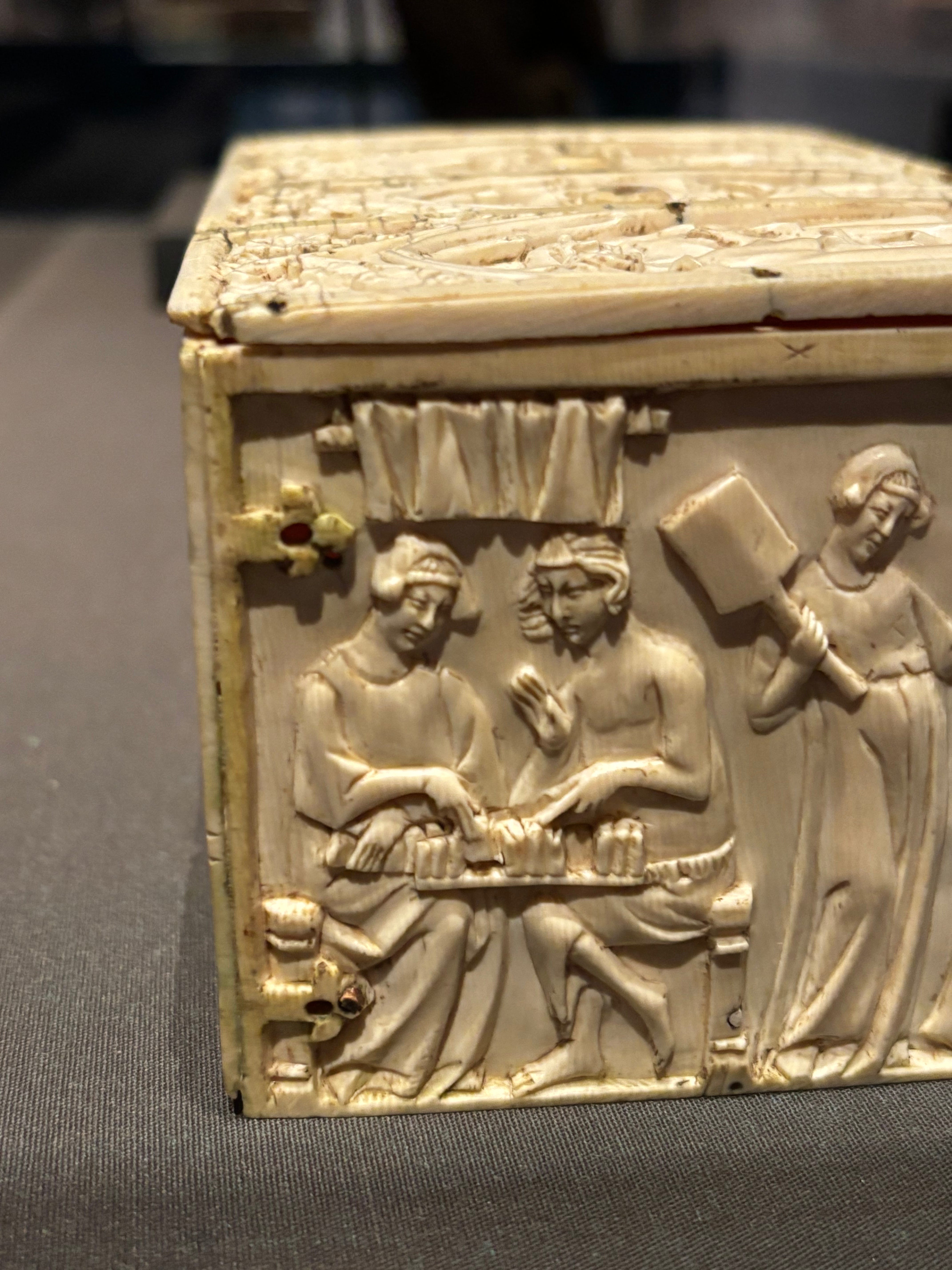
Chess has served as shorthand for courtship and intimacy in literature and art for a very long time, but seems to have attained popularity first in the medieval period in French and Spanish courts, during a period of cultural exchange between the Islamic caliphates and European courts. The game quickly became the subject of epic poems and romantic stories such as the stories of Tristan and Isolde, Lancelot and Guinevere, and Gawain. In chess, storytellers found a rich analogy for the twists and turns of courtly love: the sexual conquest of the body by taking the “bodies” on the chessboard, the intellectual flirtation that transpires between two players, the stakes of the game mirroring the stakes of intimacy.1
Unsurprisingly, present day romance novelists have inherited and made use of the romantic properties of chess in their own stories. I’ve been collecting romances with chess scenes since 2020 and they seem to pop up across subgenre and time period.2 They’re a capacious kind of scene, a Swiss Army Knife in a romance writer’s toolkit.
In part, this is because I find play to be a deeply important dimension of romance and intimacy. The act of play, with the self and the other, is a fundamentally transformative force. Child psychologist and psychoanalyst D. W. Winnicott contended that, in play, individuals are required to trust and open themselves to the possibility of a new experience. In the lightly structured space of the game, the player becomes able to creatively access new dimensions of the self. In playing with others, players must take a leap of faith that their opponent will follow the rules, play fair, play in good faith, play graciously. This leap of faith isn’t always rewarded. The very nature of interplay, or the invitation of another into the exchange, renders it a precarious, risky, exposing act.3
Opportunities for play in adulthood are few and far between, even if it’s known that play is developmentally valuable at all ages. These chess scenes, then, offer a very specific window into a character’s psyche, one that can’t be neatly replaced with other kinds of scenes and tropes. Crucially, not all games are playful. Certain conditions are required to move chess into the intimate realm. I find that romance writers are tasked with doing what Winnicott, famously, asks of therapists: to bring “the patient from a state of not being able to play into a state of being able to play.”
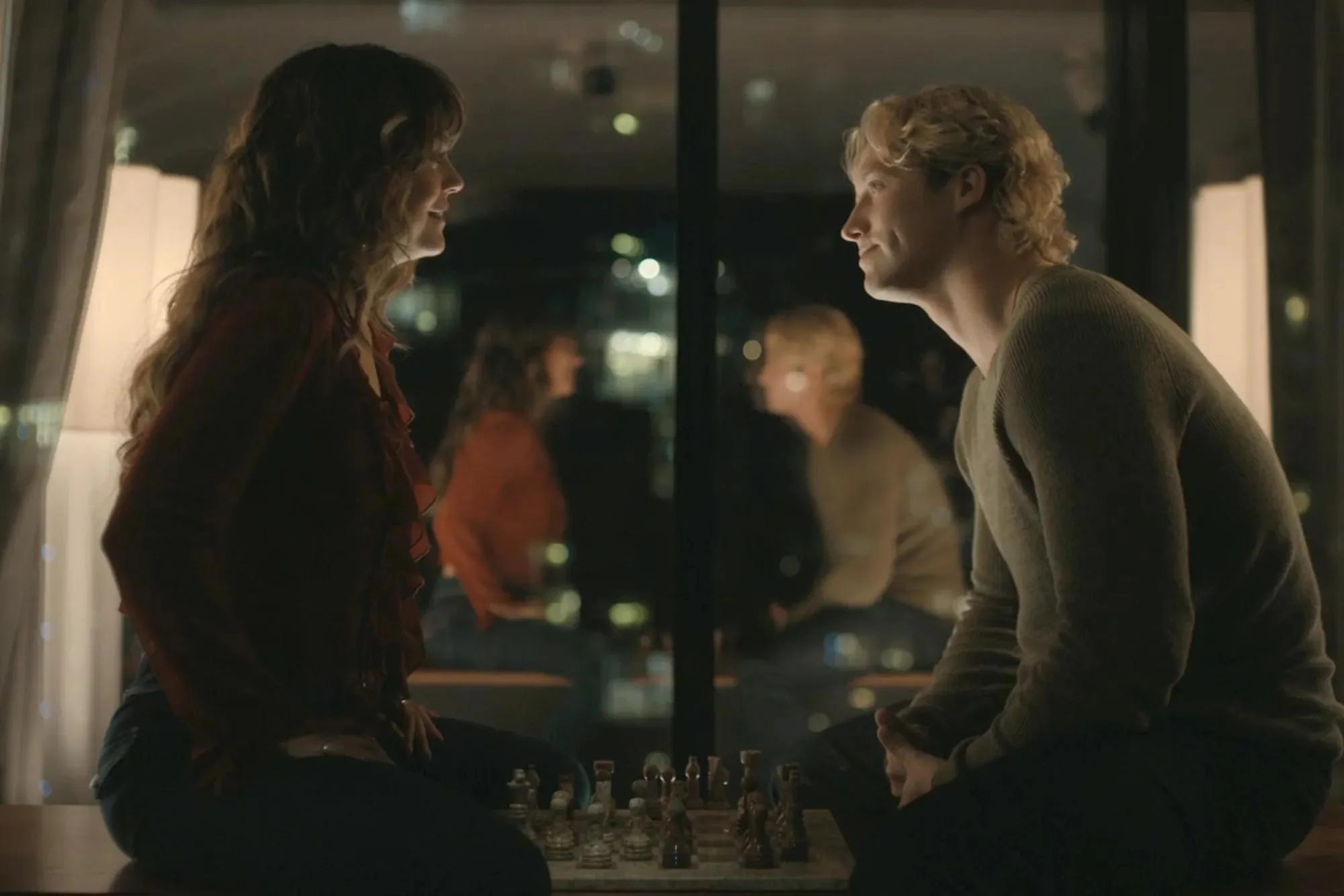
part i. the board is the love story
One of my first and favorite chess scenes takes place in Anne Mallory’s 2011 historical romance One Night is Never Enough. The story follows Charlotte Chatsworth, a beautiful, uptight diamond of the first water in the ton and Roman Merrick, a charming, dangerous, gambling hell-owner. The scene is a result of Charlotte’s gambling-addicted and opportunistic father losing her in a bet to Roman for just one night, an act that threatens to ruin her unimpeachable reputation and her ability to financially provide for her struggling family through advantageous marriage.
In Chapter 4, Charlotte arrives with her father at Roman’s home, dressed in all black as if mourning herself. Her father and others who bet in the same game for Charlotte’s company all convene to debate the morality of this exchange and attempt to persuade Roman to take another deal in vain. Roman, obsessed with Charlotte from his earliest encounter with her, won’t take anything but what he’s due. Charlotte, already chafing against the multitude of ways that men in her life have succeeded in robbing her of agency and freedom, throws her guardian’s protectiveness back in his face and insists that she will fulfill the terms of the bet before storming away into Roman’s home.
In Roman’s chambers, Charlotte is convinced they’ll have sex. She begins to disrobe, ready to be done with the transaction, but he offers her the chance to renegotiate terms. Charlotte is, rightly, suspicious. Roman, however, seems far more interested in coaxing Charlotte into conversation than into his bed. He offers another bet: if he wins a game of her choosing, she spends another night with him. If she wins, he will clear one of her father’s many debts. The offer is too good for her to pass up even though she knows he’s a predator-in-wait. She suggests they play chess.
When Roman brings out a beautiful, ornate, easily-accessible chess set, she realizes the error of her ways. He’s far more experienced and skilled than she initially anticipated. They play chess– first, in the parlor, then in his bed. He falls asleep before her, with only a handful of moves left in their match. When they wake, he kisses her. “Knight to D6.” He presses a chess piece into her hand. “Checkmate, Charlotte.”
The scene is 3 chapters long. It is a thing of total beauty.
Anne Mallory makes use of the chess scene to articulate how power shuffles back and forth between Roman and Charlotte. While the two entered the bedchambers on wildly uneven scales, Roman’s offer to renegotiate the deal on her own terms, with her own mind, hands Charlotte the reins for the first time in the novel. Chess, and the chess piece he gives her, becomes a gift of courtship. It becomes what Winnicott would call a “transitional object,” or an object that comes to signify the weight or salience of a relationship.
The scene also serves as a kind of erotic denial for both the protagonists and the reader. Charlotte– and the reader– enters the bedroom prepared for sex with a man she’s reluctantly attracted to, only to have her confusing knot of desire set aside for a cerebral, sedate game that appears uninterested in her body altogether. By the end of the scene, their only sexual contact comes in the form of an incredibly hot glove-removing exchange and a kiss. In denying Charlotte and Roman relief, Mallory strings the scene so tautly that the reader leaves those chapters with a hundred-yard stare and the sudden need to smoke a cigarette.
Among the more compelling uses of chess is its capacity to distill a romantic relationship into its most essential qualities. Roman expresses his desire to play with someone who is of “near equal skill,” stating that he hopes that, “in the end, we are evenly matched.” His inner monologue makes reference to his boredom with uneven power. He declares his intent to possess her, but follows by expressing his hope that she will possess him back. The game serves as a microcosm of their relationship, an articulation of how power and intimacy works between the two of them. Roman delights in the privilege of playing with her, the privilege of being allowed to see her cool reserve drop away. Charlotte begrudgingly delights in being encouraged and allowed to express herself more fully and directly. Whatever their obligations outside of the game, the thing that lies between them is an endless source of pleasure and life and interest.
part ii. beyond the trauma plot
In One Night is Never Enough, chess also lays bare the most essential qualities of their characters. Charlotte is revealed, both to herself and to Roman, to be a reckless, volatile player. Roman is found to be a methodical, paced player who is willing to take risks for her alone. It’s a striking inversion of their outer presentations that further illustrates their compatibility.
It’s not novel to suggest a correlation between a player’s style and personality, in fiction or in real life. I recently watched a TikTok of a chess player talking about a game he played against Peter Thiel on Chess.com. The player’s account of Thiel is perhaps predictable: too prideful to quit even when the game is lost, prone to elementary mistakes. For all that Thiel cultivates and wields a reputation as an otherworldly genius, his errors are entirely ordinary and mortal, in true techno-fascist form. As in chess, so in life.
The real interest lies, for me, in this gambit’s ability to displace the primacy of the Trauma Plot. In a brilliant 2021 essay for the New Yorker, literary critic Parul Sehgal writes of the totalizing, flattening, and boring role that trauma has come to play in contemporary literature: “Trauma trumps all other identities, evacuates personality, remakes it in its own image.” Jane Austen’s protagonists, she points out, were not plagued by mid-narrative flashbacks to early-childhood abuse and didn’t need to be in order to be understood. Anne of Green Gables didn’t need a traumatic backstory to be interesting or lovable.
Furthermore, Sehgal argues for a recognition of the pleasures of partial knowledge and the value of sitting with uncertainty in character. Even when trauma is an unavoidable feature of a character, the meticulously recounted flashback and absolute truth isn’t needed to understand why Roman Roy is into being topped or Kendall Roy is addicted to publicly humiliating himself. The ambiguity of their upbringing is, in part, what makes patriarch Logan Roy so chilling.
While Sehgal was writing about largely literary fiction and nonfiction, I’ve seen the fingerprint of trauma in romance, too. Romance after romance building its way to a dramatic 3rd-act reveal of a core, essential wound that unilaterally explains Why A Character Is Like That. His mother had cancer. Her ex-boyfriend was a cheater. His old boss was abusive. She lived through a natural disaster. The act of disclosure alone is elevated to holy confession. In explaining Why They Do That, they become Absolved by the narrative. Character: unlocked. Character defects: forgiven. Conflict: resolved.
I don’t mean to be flippant. Our experiences do, obviously, shape us. Trauma leaves indelible marks on the psyche that are worth exploring in romance. I do, however, tire of on-page discussion of trauma as a skeleton key of a plot device. Characters must be legible to readers beyond and before the traumatic incident is revealed, if revealed at all. Chess, in this context, reminds us that there are “odd angularities of personality,” that transcend tidy understanding. There are parts of us that cannot or should not be neatly explained by personal history and injury.4
In Whitney, My Love, Judith McNaught’s divisive 1985 historical romance featuring Whitney Stone and Clayton Westmoreland, Duke of Claymore, a chess scene is pivotal for understanding what lies between the protagonists. Clayton, who is attempting to woo headstrong and beautiful Whitney away from a childhood crush, lures her into a game at his home. Clayton is well suited to conquest and plays that way. While he intends to court Whitney thoroughly, he has already secured her hand by bribing her father without her knowledge. His intentions are to own her, to possess her like a shiny trinket. He manipulates her, in her own words, like a pawn. He wins the game, but not without trying. Whitney, in his words, plays “one hell of a chess game.” The game and his reaction to it shows us the degree to which he seeks dominion over her but also the degree to which he cherishes her bright, fierce spirit. That, too, is a compelling portrait of his character.
Whitney is a challenging book for many reasons. McNaught dares the reader to try to understand Clayton outside of and without the gesture towards trauma. While Whitney’s upbringing and neglect at the hands of her father are discussed on-page, Clayton gets no such backstory and even Whitney’s “trauma history,” hardly provides a complete understanding of her bold, boyish, whip-smart personality. In the pages following the chess game, both Clayton and Whitney hurt each other in enormous, irrevocable ways. Clayton violates Whitney in a way that could be seen as unforgivable. There is no reprieve from their repeated betrayal of one another, no “big reveal” that clarifies how Clayton had reasons to treat her the way he did. And still, as in chess, so in life. It would be difficult to dispute that they are well-matched. By the time I arrived at the “happily ever after,” I felt more of a complicated kind of relief than I did joy.
Without the shorthand of trauma, we are left to speculate why Clayton is the way he is but I wonder if it is required to know why for us to understand exactly who he is. Can the reader tolerate the uncertainty of not knowing why? Can the reader make do with the portrait we’ve been given? It is exactly that tension that makes Whitney so frustrating and memorable. Admittedly, the discomfort of not knowing why does not stop me from finding Whitney and Clayton to be deeply romantic and, at times, sympathetic.5
part iii. ethan hawke, romance scholar6
In just about every chess scene, the game blooms with the players. Distracted by the game– or maybe revealed by it– characters share more than they would without the board in between. In Preferential Treatment by Heather Guerre, the game draws out billionaire Mikhail’s interactions with his domme, Kate, beyond the confines of their kinky relationship. In The Gentleman’s Gambit by Evie Dunmore, the game is a tool of seduction for Elias, who requires Catriona’s trust to pull off a heist. In Run Posy Run by Cate C. Wells, mafioso Dario Volpe discovers that Posy Santoro’s chess play, far and above her physical charms, is the thing that makes her precious to him and worth fighting for. Over and over, characters who set out to win something unwittingly find themselves rehearsing intimacy in new combinations and permutations on the board. Over and over these scenes unveil the singular pleasure of playing a good game with exactly the right person.
Winnicott formulates play as an act of discovery and pursuit. “Playing is doing,” he writes. Perhaps this is part of why I find these scenes to be so persuasive. In playing chess, I watch characters move from telling me about their intimacy to doing intimacy: the ritual, the rules, the time spent, the attention directed, the mutual observation, the need to reach into the mind of the other, if only to anticipate how best to beat them.
For me, the most persuasive romance arcs manage to, eventually, shift the terms of engagement from conquest to play. The most satisfying chess matches, ultimately, aren’t in the transactional pursuit of winners and losers. The best matches show me what is worth surrendering for. Regardless of the outcome, the one who plays always wins.
Read a few different things on chess to inform this:
Juel, K. (2010). Chess, Love, and the Rhetoric of Distraction in Medieval French Narrative. Romance Philology, 64(1), 73–97. https://www.jstor.org/stable/44741914
Kobs, Z. (2025). Chess as a Visual Language: Women Playing Love in the Medieval Courts of Spain and France. Undergraduate Theses in Art History. https://digital.sandiego.edu/aaah-utah/1
Rendall, T. (1992). “Gawain” and the Game of Chess. The Chaucer Review, 27(2), 186–199. https://www.jstor.org/stable/25095796
Sharples, J. (2017). A cultural history of chess-players: Minds, machines, and monsters (1st ed.). Manchester University Press. https://www.jstor.org/stable/j.ctvn96hqj
In researching this essay, I polled my Instagram followers for examples of chess romances written by and about non-white people and came up appallingly short. Barring Evie Dunmore’s The Gentleman’s Gambit, the only titles that came up were Sherry Thomas’s Not Quite a Husband features a chess scene between two white protagonists and Courtney Milan’s The Duchess War features a white woman with a secret past as a chess player. Both Thomas and Milan’s novels are excellent, but don’t fit the bill of chess romances about non-white people.
I’m no stranger to the fact that chess’ appeal has to do with its status as a game for the aristocratic, wealthy, and culturally refined European elite. Regardless of the game’s origins in sixth century India and considerable cultural history in the Middle East and North/East Africa, chess’ perceived respectability is a feature of whiteness.
Still, my own experience of watching people play chess in the city has never been a monoracial one. Chess’ appeal seems to transcend class and race, but our stories about chess haven’t quite caught up. I yearn for chess in romances by and about POC. I want to see BIPOC characters play. If you’re writing one, send it my way. I’d love to give it a read.
Also, this is to say nothing of how straight this particular convention seems to be even though it’s well documented that medieval chess was a ripe analogy for homosocial desire too.
Adams, J. (2004). Pieces of Power: Medieval Chess and Male Homosocial Desire. The Journal of English and Germanic Philology, 103(2), 197–214. https://www.jstor.org/stable/27712415
A few sources here:
Baxter, L. A. (n.d.). Forms and Functions of Intimate Play in Personal Relationships. Retrieved June 28, 2026, from https://onlinelibrary.wiley.com/doi/10.1111/j.1468-2958.1992.tb00556.x
Cornell, W. F. (2015). Play at Your Own Risk: Games, Play, and Intimacy. Transactional Analysis Journal, 45(2), 79–90. https://doi.org/10.1177/0362153715586185
Davis, M., & Wallbridge, D. (1991). Boundary and space: An introduction to the work of D.W. Winnicott. Karnac Books.
Lenormand, M. (2018). Winnicott’s theory of playing: A reconsideration. The International Journal of Psychoanalysis, 99(1), 82–102. https://doi.org/10.1080/00207578.2017.1399068
Ntelia, R. (2020). Romantic Love in Games, Games as Romantic Love. International Conference on the Foundations of Digital Games, 1–4. https://doi.org/10.1145/3402942.3402968
Winnicott, D. W. (1991). Playing and Reality. Psychology Press. ← this is the important one, but the Lenormand and Cornell pieces were particularly influential on me.
Admittedly this is, perhaps, a topic that requires more time and attention than this substack alone can offer. I’m trusting that this will be read in good faith as a critique of incomplete writing, not a critique of the real experiences of traumatized people.

I’m sure you’ve seen this, but if you haven’t:
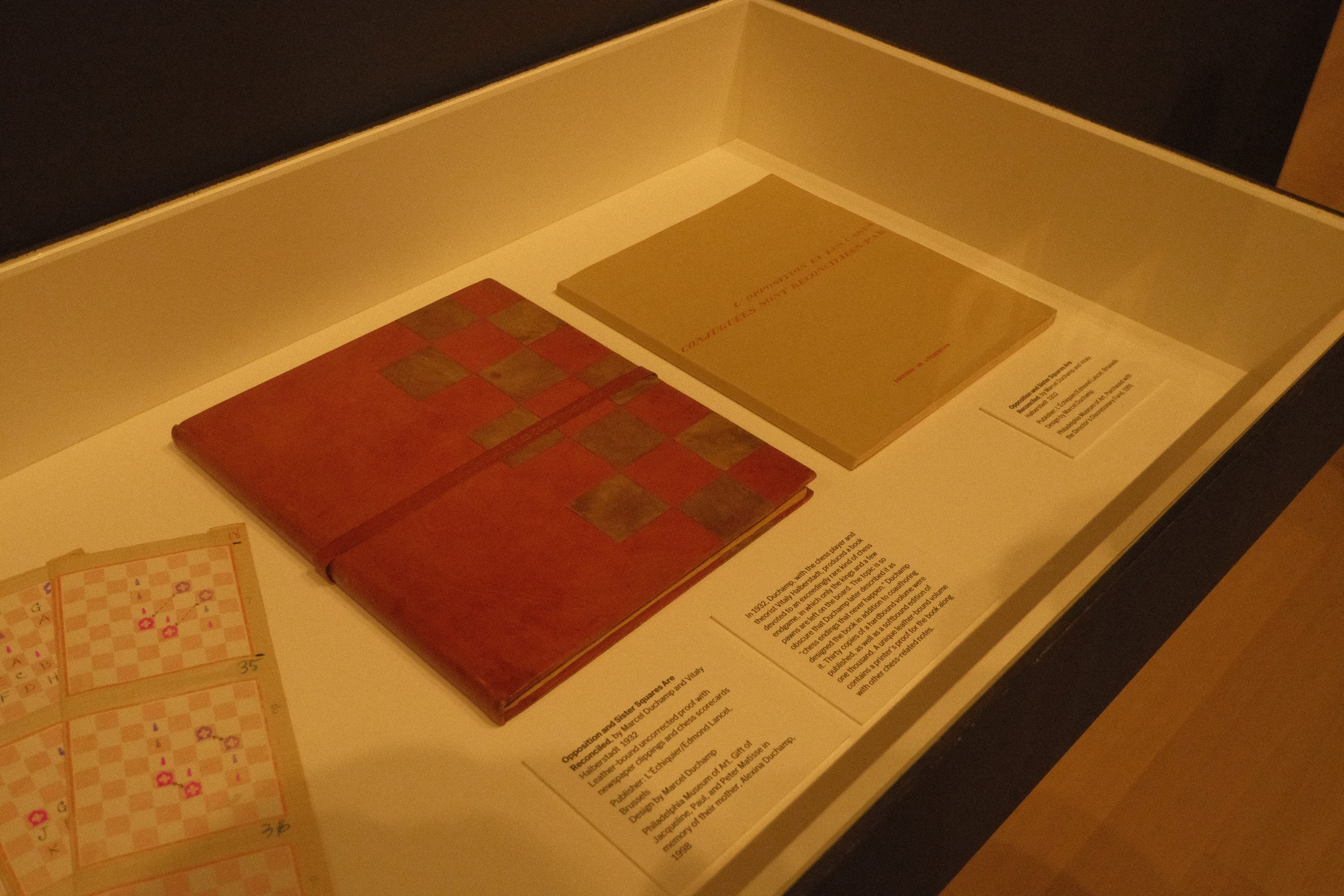
This helped put into words what I found so captivating about Challengers! The use of tennis as the way to demonstrate how they play and what theyre willing to surrender to.
The Trauma Plot article is fascinating— like why this insistence that characters must have and express their wounds to be “interesting” or “sympathetic?” Most of my favorite art recently shows enough restraint to leave me with more questions than answers