
enemies2lovers
more casual notes on power & love

this is a short post kind of extending on dynamics I explored in my last substack! very casual, very half-baked.
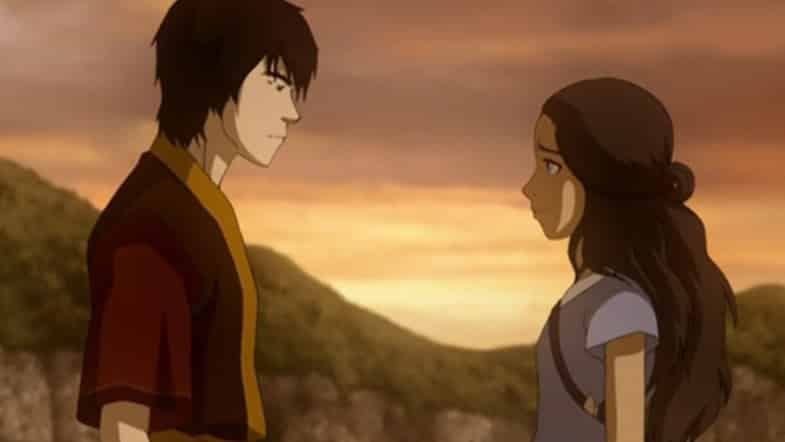
I only got around to watching Avatar: The Last Airbender in 2020 when all of the seasons dropped on Netflix and I, like many others, suddenly had a bunch of free time to spend at home and nowhere else. I was, maybe predictably, a Zutara stan. I find the tension of opposition so interesting— in my last substack I referenced the setting of enemies-to-lovers novels as a void, a place of “lively tension,” or “empty jubilation,” echoing physicist Karen Barad.
In part, the dynamic appeals because I like dialectics, which refers to the process by which many opposing views/forces/ideas are held and explored in service of arriving at a truth (or many truths) through repeated inquiry1. Katara and Zuko are thesis and antithesis, water and fire, and it’s through their proximity to each other and their opposition to each other, that both of them become different. I would even say they become more truthful versions of themselves. Honestly, it’s just interesting when characters are at odds with each other. It’s fun to read stories where opposing forces become entangled. The things that become revealed by the process of enmity and reconciliation are often rich and textured.
I know, now, that many people have strong reactions to Zuko as a character and Zutara as a pairing. While there’s considerable praise for his eventual redemption arc, most of which is contained in the last season of the show, there’s also a really robust criticism of the Zutara pairing as one that romanticizes settler-colony relationships.2 I think there’s merit to the concern that much of hetero fiction is preoccupied with the redemption and transformation of powerful, often violent, often cruel people: Reylo, Dramione, Darklina, Zutara, and on and on and on. I understand objections from people who see these portrayals as imbuing such figures with false-consciousness— that is, manufacturing humanity in figures who would not do the same for you and, in truth, probably do not have too much humanity3 to begin with.
And still! I am compelled! Why! I have a few theories. My more cynical reading is that desire for an oppressor, expressed in these kinds of ships, is desire for proximity to power (I talked about this more in my essay on heteropessimism, though in kind of a hopeful way) or the security that can be granted by proximity to power.
My other reading is that the utility of keeping the “oppressor,” close is the continued reminder that we could, at any point, through any amalgam of choices and structural forces, become him.4 Oppressors are often skilled in eliciting sympathy, are often convinced of their own righteousness, are often steadfast in their own victimhood even when presented with contrary evidence. Part of the utility of making the oppressor a figure who can be transformed— not just reformed— is that we become reminded of the fact that we can be transformed too. It is easy and convenient to think that villains are far away. It is easy to think that good people go on doing good things in perpetuity. In actuality, borderlands between victim/perpetrator and oppressed/oppressor are, at least historically speaking, troublingly porous.5
I find it useful when critics of such dynamics point out that these stories don’t go far enough or do enough to transform its characters. The reality is probably, also, that readers work too hard to make these kinds of dynamics seem ultimately “hopeful,” and optimistic. There is also a world in which these kinds of enmeshments between people happen and a mutually assured destruction follows, which the darker side of fic and romance also explores. That, too, can be narratively interesting in a kind of fatalistic way. What I mean by this is that it is perhaps useful to let go of the idea that people in romance novels must be “good people,” or, at the very least, the arc of all romance must skew towards goodness in the end.
Admittedly, it’s easy for me to talk about this in fiction and in the context of fictional power structures. That is, of course, one of the utilities of fiction. My empathy stretches longer, my judgments are softer, my ability to speculate on the possibilities inherent to intimate relationships is greater. The reality is that fictional violence offers a degree of removal— by necessity. One can close a book, return it to the library, and never think about it again. Real-world violence, however? Inescapable and relentless in its reach.
I don’t feel any particular way about people who enjoy these kinds of ships, mostly because I’m not too invested in the idea of ships as evidence of good-or-bad politic. One can hold all of the “correct,” opinions and never act on them meaningfully. One can also have truly diabolical taste in fiction but also invest deeply in their communities at every given opportunity. Intellectual currency online is, of course, only equipped to evaluate one of those things.
It’s also true that when I watch ATLA, I find both Zuko and Katara to be deeply sympathetic characters, together and apart. I don’t identify with just one or the other— if I’m self-inserting, here, I’m self-inserting as both because I’ve seen myself in both. It serves to be curious about that, rather than judgmental, I think.
I come to this as a psychologist-in-training, not as a philosopher. Dialectics is a big part of how I think about clinical work (how can we move between the need for acceptance and the need for change? what fruitful things lie in the tension between those two opposing needs?). The definition I offer is pretty shit, but I didn’t think it was worth getting into Marx and Hegel and Fichte here.
In the case of ATLA, Zuko and the fire nation is often understood as a stand-in for Imperial Japan and Katara and the water nation are often understood as indigenous arctic peoples - namely Inuit people. Important to note that they aren’t 1:1 comparisons - this is still a fictional world, and we are still talking about fictional harms, because it would maybe be a disservice to the real people who experienced Japanese imperialism to suggest otherwise.
let’s set aside that I take kind of a critical post-humanist view of our world for a second, for the sake of exploration
See: current events
can you tell that I’ve been rereading Necropolitics (Mbembe, 2003) again
I saw Zuko and Katara and my ears perked up like a puppy! Great and insightful read 👏🏾
"I understand objections from people who see these portrayals as imbuing such figures with false-consciousness— that is, manufacturing humanity in figures who would not do the same for you and, in truth, probably do not have too much humanity to begin with."
Ooof. So well said.